
Dispatch from Shanghai
The beauty of urban quiet, and the bold clarity of carrots and sticks.

The Shanghai metro sprawls in every direction across this vast metropolis of 30 million souls, and one of its more than 500 stations sits right beneath the gilded Jing’an Temple. So it was that only after a wander through the relative calm of that gorgeously atmospheric, incense-scented complex that we actually emerged onto the streets of the city. And it wasn’t until ten minutes after that, when standing at a large intersection on Changde Road, that what was so unusual about this city rose from my nervous system into my actual consciousness.
This city was unnaturally calm.
I had not expected this, and my senses hadn’t been attuned to it. I had expected Shanghai to be noisy and gritty, filled with endless traffic and, above all, the incessant roar of motorbikes. That was my picture of a big Chinese city, a preconceived notion reinforced by the thick layer of smog that enveloped the city.
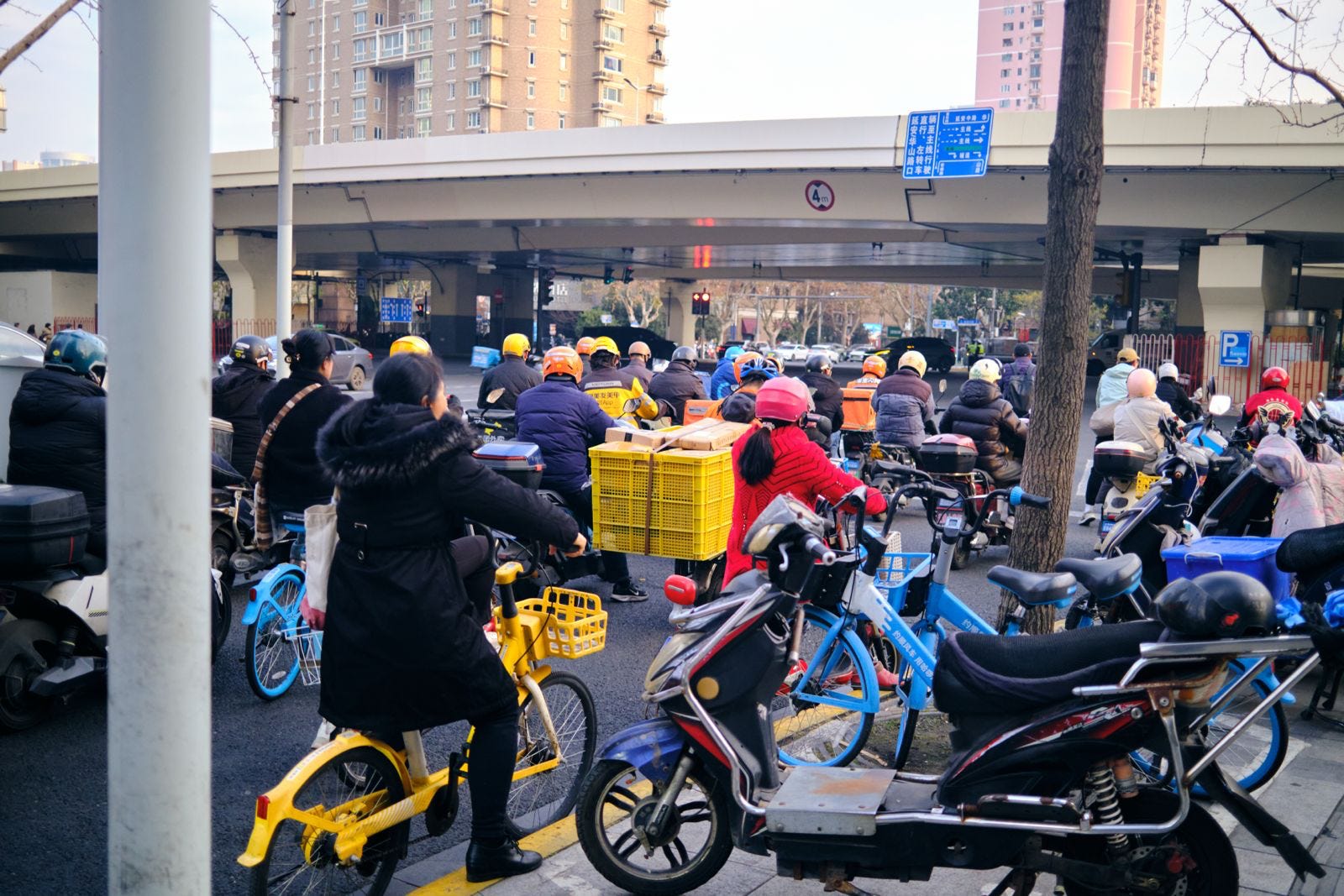
And there was tons of traffic, to be sure. It was constant. There were motorbikes, too, and plenty of people, though the streets of relatively low-rise Shanghai were no were near as crowded as its audacious Pudong skyline might suggest. There was all of the business and bustle of a central district of any major city. And there we were, standing beside the six lanes of traffic on busy Changde Road, and Cedric and I were speaking to each other in tones not much above a whisper. (Seriously: it was absolutely hushed when he took that photo up above.)
The explanation to this calm, which was almost unnerving to my ears that are so used to the cacophony of Paris and New York, lies in Shanghai’s stringent approach to vehicle regulations. It begins with registration, which is free of charge for electric cars, which are relatively quiet. Registrations for conventional vehicles, on the other hand, are purchased at auction and can cost around 90,000 yuan (about 13,000 USD), a hair less than the average resident’s entire yearly earnings after taxes. That’s a powerful incentive to shift from regular vehicles to less-polluting, quieter electric ones, especially as the auction system itself shifts car ownership from a right to a privilege, a sensible paradigm shift given the enormous externalities that mass vehicle usage imposes on city streets and residents.
Regulations of motorbikes are even stricter. The city banned sales of two-stroke engines, like those used in motor scooters, thirty years ago, and motorcycle license plates cost 300,000 yuan (over 43,000 USD), which essentially rules out their use by everyday Shanghai residents—a startling difference to the central role those polluting machines play in the daily life of many large Asian cities.
And yet we saw plenty of motorcycles and bikes in addition to the electric cars quietly whooshing around the city. Nearly all of those two-wheelers ran on electric power, too, which lets residents move efficiently through the city’s sprawl while keeping the city’s neighborhoods and streetscapes relatively quiet and calm. Although more than half of daily trips are taken on foot or by transit in Shanghai, all those relatively quiet bikes and cars provide useful alternatives in the (ever fewer) places that the enormous Shanghai metro doesn’t reach.
The upshot, for this noise-averse visitor, was an unexpected lifestyle envy in a city that I expected to find blandly overbuilt and overrun with noisy traffic. Much of the city’s newer development is overscaled, and much of it sadly replaces the city’s disappearing stock of remarkable heritage architecture. But Shanghai proved that, at least when it comes to noise, even the centers of very big cities—even those with a considerable share of people using motorized transportation to get around—really can be quiet and calm. It just takes a commitment to change.
I say “just,” but the reality is that changing cities is really difficult. And, Chinese cities aren’t great case studies for American and European ones given China’s vastly different policy, political, cultural, and regulatory contexts. But we’re all similar in one particularly difficult dynamic: people view driving (or motorbike riding) nearly as a birthright, and governments struggle mightily to get people to switch to walking, biking, and transit. It’s worth considering, then, that Shanghai managed to hold car ownership down during a period of massive expansion in household buying power. As Chinese society became richer, and Shanghai joined the ranks of the world’s capitals of conspicuous consumption, the city paired the disincentives of its strict licensing structure with an enormous expansion of its metropolitan transit system, creating a powerful positive incentive for residents to reorganize their newly flush lives around cleaner and more efficient ways of moving around the city.
Compare that to Los Angeles, a similarly sprawling megacity which has embarked on a laudably ambitious expansion of its own transit system in recent decades. The expansion is major in US terms but nothing on the scale of what is needed to fundamentally reorganize how everyday Angelenos move around their traffic-choked city. And that weak incentive to use transit saw no parallel regulatory approach to reduce car ownership and usage. As a result, the city still sees fewer than 5% of people using transit for their daily travel around the city.
These are complex cities embedded in complex and unique political and social landscapes, and direct comparisons like this can only offer lessons in broad strokes. But the broad lesson we can take from the quiet streets of bustling Shanghai is a simple one: expanding transit options only goes so far toward getting butts in seats, and the real shifts happen when we also disincentivize driving in clear, stringent, and even financially punitive ways.
If that approach sounds politically unpalatable, so be it, and let’s start tackling those ugly politics. After all, cars have made a pretty ugly mess of our cities, and it’s past time to start being direct and honest about that. The path to a more climate-secure future runs through cities that are clean, attractive, affordable, vibrant, and quiet. Cities need to feel sane and comfortable in a way that New York, for example, currently does not. Getting there will involve difficult political trade-offs; if it didn’t, we’d already be there. We cannot continue to just cross our fingers that others will make cleaner choices in their everyday lives while government policies tacitly encourage cars as the fundamental organizing principle of life in cities. Shanghai flips that contradiction on its head, positioning the ownership of polluting vehicles as a privileged exception in a city so well served by quiet and efficient transit.
There are no easy answers to solving complex problems, and I don’t mean to position Shanghai as a kind of “one simple trick.” But at some point we’ve got to start insisting on bigger, bolder visions for a better future. At some point we’ve got to ask each other and our governments to allow ourselves some transformative changes. And, to do that, at some point we’ve got to face the challenging trade-offs head-on. Cultural change happens over time, but government can’t always wait for cultural change to happen first, which is the politically easier path. Shanghai shows how government can push us along with regulations that disincentivize what we need to move away from while building systems that make us clamor for a better future. Shanghai shows how beguilingly pleasant a quieter and less polluted city can be, even if the city is still too full of cars. It’s a really strong start; why shouldn’t we insist on it in our own cities, too?